

Overview
Honest Fellow
Men's online fashion brand that curates to the shopping needs of men and supports slow and sustainable fashion.
While researching a topic for my case study, I had made up my mind to study e-commerce in fashion and clothing. During the process, it struck me that my ideas inclined more towards women's fashion needs, women's clothing, beauty products and my process revolved around 'Online Shopping' & 'Women'. This got me thinking, What if I study and understand men's shopping behaviour and address their pain points!
Problem
The fashion industry has always been more focused on women's shopping behaviour than men.
According to IBIS World, the market size of the Online Men's Clothing Sales industry in the US has grown 7.9% per year on average between 2016 and 2021. With the increasing demand, it has become even more important to address the frustration of men when shopping online. In this case study, I am going to study the habits, needs, motivations and pain points of men shopping online, and create a product that provides exclusive and ethically manufactured men's casual wear, offering a hassle-free online shopping experience.
Outcome
An online shopping experience for men that addresses the frustrations of purchasing online, and provides an elevated and positive buying experience.
-
Sustainable brand
-
Pay later feature
-
Easy returns & exchange
-
Donate with free shipping and fewer carbon footprints

Project Opportunities & Goals
Key Focus Areas & Goals
Opportunities
-
What is the online shopping pattern of men?
-
What are the areas of frustration in shopping online? ( My to-be problem statement)
-
What influences the shopping decisions?
-
How quickly are the purchases made?
-
What drives men to a specific online shopping website?
Goals
-
To create a smooth online shopping experience
-
To solve the problem areas in the process of searching for a product, viewing it, reading the details, adding it to the cart and checking out.
-
To create post order journey screens that increases the confidence of customers in shopping online from Honest Fellow
-
To create features that make purchasing and paying for products more reliable and trustworthy.
Research
Internet Research
Reading the online treasure of information
I was sure there were probably multiple studies already done on men's shopping habits. I read articles with different studies and below are my insights.
Key Findings

-
84.3% of men buy online compared with 77% of women. ( Study by Affinet Reports)
-
Men need personalized experience and prefer exclusivity with their customer service.
-
The online experience is preferred for convenience and more options.
-
Most users browse through phones but prefer viewing the product on a larger screen like a laptop to view the product images.
Quantitative Survey
Screening participants & collecting statistical data
The market research helped me in understanding the general statistics of men's shopping thought process. I also referred to a few case studies to see if my mental model of conducting the research is on the right track. My next step was to conduct qualitative and quantitative research.
Why quantitative?
-
To learn how many of my target users were interested in online shopping
-
To find how many users could become potential customers of 'Honest Fellow', which means to understand if there is a need for the product I intend to create.
-
How much time do men prefer spending on shopping

User Interviews
Reading the feelings, actions & emotions
I believe conducting user interviews is the foundation of developing any product. I conducted user interviews to determine patterns, pain points and needs of men who shop online. It was important to drive the users to understand the frustration and pain points.
The reason to choose participants who were specifically not very keen on online shopping is to understand the 'Why' of not wanting to shop online. View the research plan here.
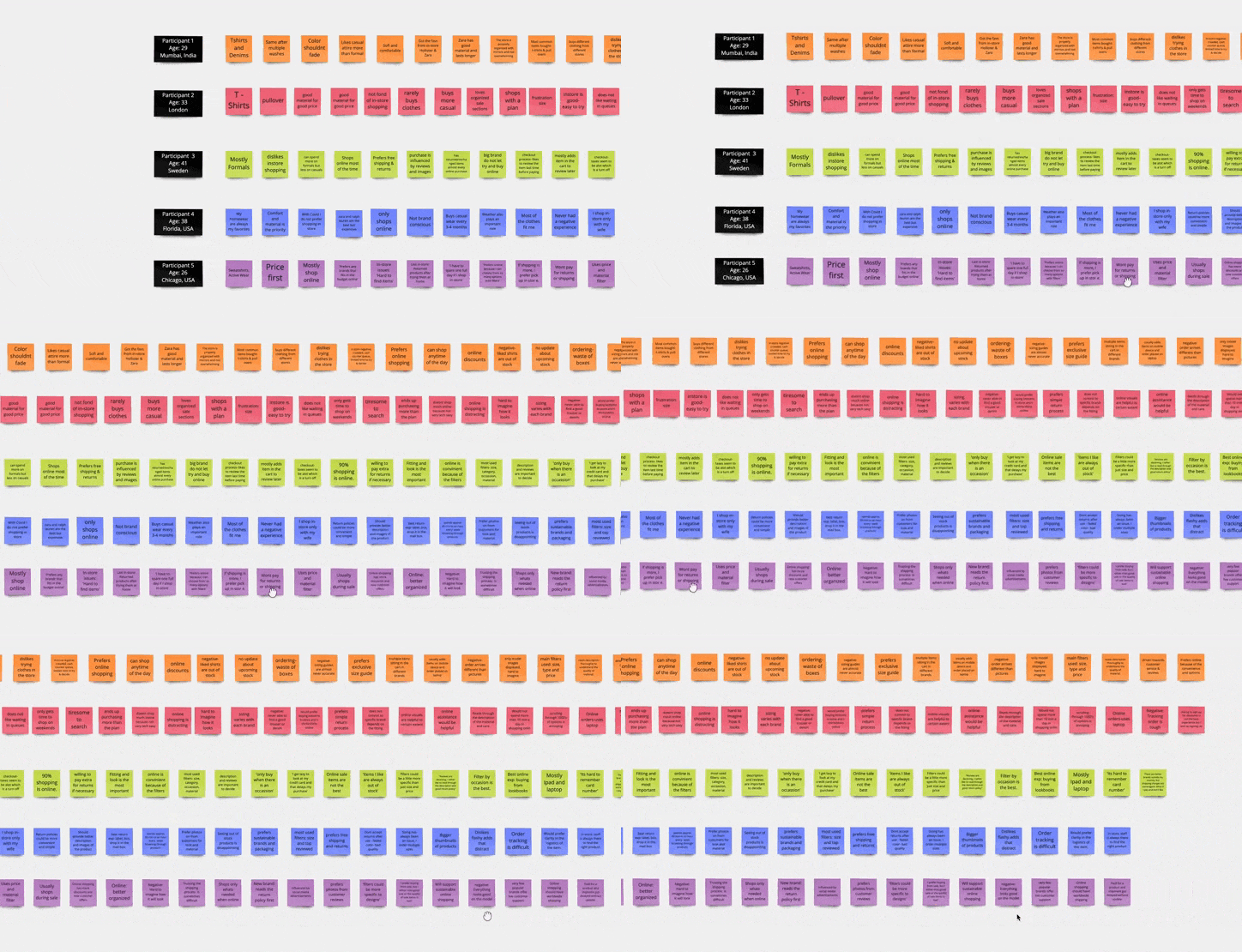
Key Findings
-
The in-store experience is preferred for the touch and feel of the product.
-
Users visit a fashion website with a specific item in mind to shop. Eg: X wants to shop for a sweater, X searches for the keyword 'sweater' and expect to see only those items.
-
Users feel insecure looking at the model images to display products.
-
Almost all the users expressed their disappointment in the fitting & measurements.
-
The end experience of checkout, is still a bit frowned upon since users have to look for their credit/debit cards to finalize the purchase.
-
Free returns and exchanges build trust in the shopper
-
Men tend to be more brand-specific, however, research revealed that the reason to choose these high-end brands is primarily 'quality of clothing' and 'customer service and not the 'brand tag'.
-
Users are less inclined to discounts and more towards the quality and ease of finding a product.
-
The target audience's interests are majorly driven by modern technology.
-
Males tend to intensely research a product page and read the description, while women skim through pages and jump to next in search of a perfect product.
Thematic Analysis
Understanding the patterns in the observed responses and behaviour.

Filter & search options more specific to size and fit.
Reveal Key Insights
Dislikes trying out clothes in-store but prefers it.
Buying decisions are influenced by social media
Competitive Analysis
Opportunities I can add to 'Honest Fellow' to stand out from its competitors.
Below is the analysis of brands that offer men's wear. I chose these brands based on the responses I received from the interview participants. I analyzed these brands to see what I can learn from their design and what are opportunities I can add in 'Honest Fellow' to stand out from its competitors.

Define
Creating Persona
Creating a foundation for brainstorming and feature prioritization.
Following my qualitative and quantitative research data, I synthesized the information and created user journey's and persona. This helped me in creating a strong footing for brainstorming and feature prioritization.


Point Of View (POV) Statements
Capturing the design vision & addressing the right challenge
-
Charles recently bagged a job as an animator and need to revamp his wardrobe with more ethically manufactured casual wear since his workplace has a casual environment. Because Charles is a mindful shopper, he wants to make a thoughtful purchase but also needs his new collection delivered within a day or two.
-
Rahul, a busy professional, does not find time to shop in-store anymore and needs to start trusting the online websites to make purchases. He hesitates to shop online because he thinks he will have to compromise on quality and go through the hassle of returns & refunds.

How Might We (HMW)
Joining the gap between the define phase and the ideation phase.
-
HMW give a man a thorough overview of a product?
-
HMW reduce distractions of undesirable product displays on the website?
-
HMW gain the confidence of a user in our manufacturing process?
-
In what ways can we build the trust of users in shopping online?
-
What would happen if payment is made after delivery?
-
HMW we reduce the hassle of payment information?
Ideate
Feature Ideation
Brainstorming session
Ideation is one of my favourite phases in the design thinking process. It allowed me to generate rapid ideas for the UX and UI of a product. With all the research data through interviews, competitive analysis, HMW questions I began brainstorming solutions for the problems I synthesized so far.

Feature Prioritization - Impact v/s effort matrix
Prioritize tasks based on what will most help them achieve their ultimate goals
Using the Impact v/s Effort matrix, I prioritized the potential ideas and features that I worked on during brainstorming.
Again, with the help of my husband (developer) I got a fair idea of how much operational effort would these features need and weighed them against the business benefits and user needs.
.jpg)
Key Takeaways
Design for a cause
Explore the 'Try & Buy' feature
Explore the 'Pay Later' feature
Free returns, refunds and exchanges.
AI support for sizing
Live customer support for product details
Incorporating technology
Transparency in manufacturing
Loyalty Program
Feasibility, Viability, Desirability & Sustainability
Heart of the design thinking process
This phase is the heart of the design thinking process! My aim was to build a product through an iterative, human-centred process. This means the case study involves careful consideration of the business and technical side of the product 'Casual Fellow'. Questions like- How expensive will this feature be? How much time will the developers take to build? What are the market realities that I need to consider for this product to become successful?

Information Architecture
Using card sorting & tree testing to understand the mental model
Using Card Sorting was the best way for me to understand how users navigate through a shopping website. The strategy was to provide only the essentials when a user searches for a product. Considering user needs, behaviours and tasks I created the site architecture and tested it using Tree Testing.

Task Flows
Representing user journey through various tasks
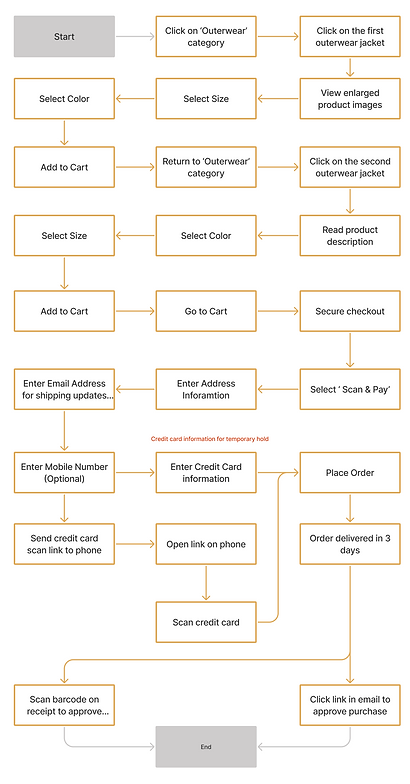
I worked on the task flows of three different tasks to understand the potential path of completing a task typically, irrespective of any external circumstances affecting any decision. I took enough time to carefully edit and redo each task to fit the mental model of the user. Representing this ideal journey helped me in moving to the next step of user flows.
Task 1:
Add one red flannel t-shirt of medium size and one any colored chino XS size in the cart
Task 2:
Add any 2 outerwear and checkout with scan & pay
Task 2:
Donate old ‘Casual Fellow’ Clothes


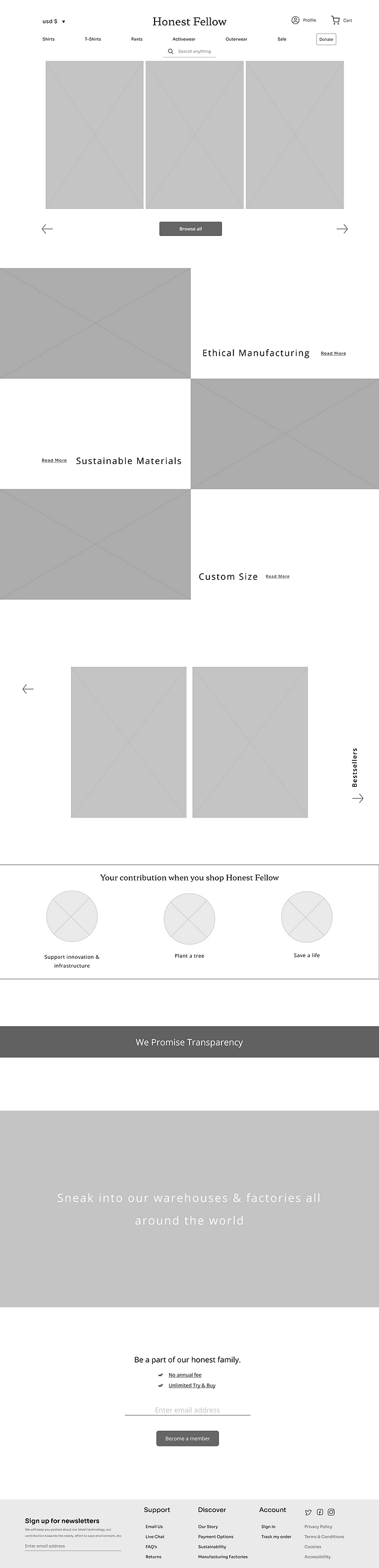
Low Fidelity Mockup
Dumping all the ideas on paper backed by research
Feature prioritization, User flow and task flow helped me in identifying the key features and typical mental model of a user. Moving on, I developed quick wireframes keeping in mind the analyzed mental model.
Key Factors:
Apply usability principles
-
Consistency in visuals
-
Feedback
-
Help users with error pages
-
Recognition over recall
Consider priority of features
Visibility of information
Needs-based navigation
Guided Selling
Error Screens


Prototype
Mid-Fidelity Prototype
From scribbling ideas to developing prototypes
As a designer, I always juggled between using pen & paper and using the software. My brain functions with a combination of both. I created multiple sketches ( I had approximately 30 pages of sketches). Most of them only had a few lines on them, but each sketch sparked a new idea.




Usability Testing
Testing User Stories
With the help of my LinkedIn connections and peer connections, I was able to test my user stories. I invited about 6 people to test my mockup and the results gave me a great insight into where I was falling back and shed some light on the important parts of online shopping.
Key Findings
-
5 out of 6 users after browsing through the mock-up, said that they were not aware of the AI used for virtual body measurements.
-
All 6 users were able to successfully reach the checkout page.
-
Users expressed happiness for the donation initiative since they felt that they can buy more clothes guilt-free if they can return the purchased clothes for a good cause. Shopping = Doing Good
-
4/6 Users scrolled to the bottom to view the reviews section
-
All the users tapped on the 'How it's made' section, which showed curiosity in understanding how the shirt they liked is manufactured. This increased the buying rate.
UI Kit

Hi-Fi Prototype
Incorporating testing results into the final iterative prototype
Based on the insights I collected from the usability testing, I developed and finalized the final prototype.


Features
Focusing on the features based on the needs and pain points

Immersing into the men’s online shopping behaviour to identify the patterns of reading revealed that men read about the make and technology of a product.
Eg: I sent a link to a men’s shampoo & an analogue watch to one of my friends and observed his way of learning about both the products.
Insight
Both the products were meant for different lifestyle use. The user carefully read through the make, model, year of manufacture thoroughly. I assumed that for shampoo he wouldn’t bother much about going into the details, but I was surprised to observe that the user read the ingredients and the description of the shampoo thoroughly.
How It's Made?
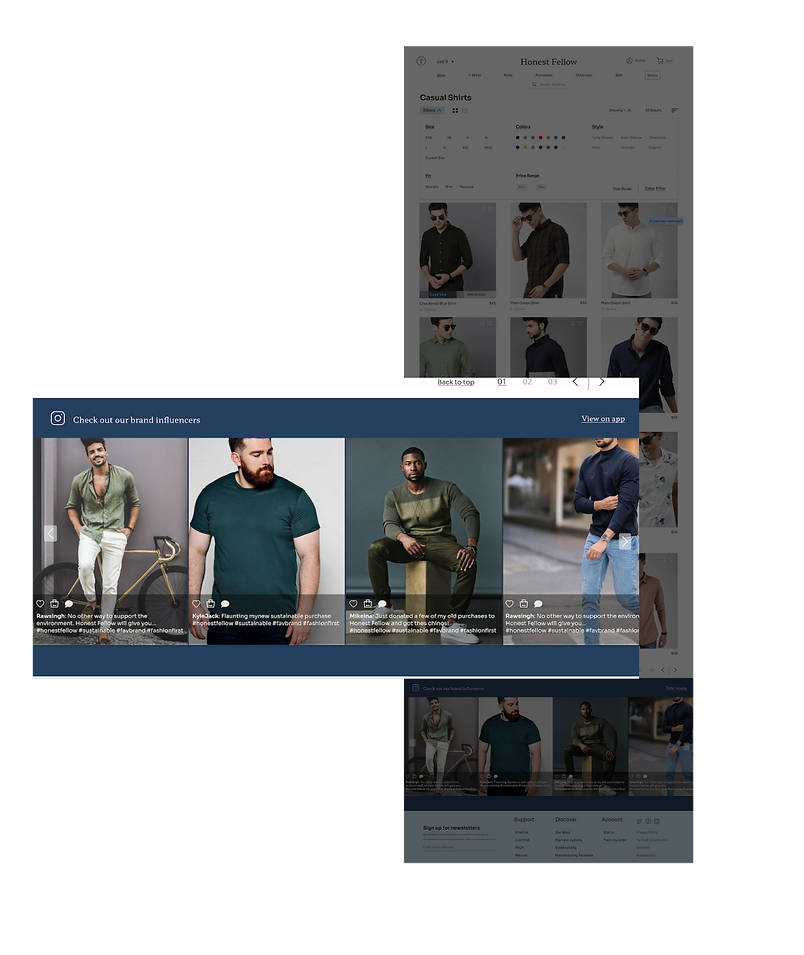
Customers that are not looking for specific product reviews usually are found reading the brand's social presence. Especially in a generation where platforms like Instagram and Facebook are most used, these platforms act as a stage for brands to stand out by having influencers promote their product.
Studies also revealed that 42% of the users I interviewed were directed to a product through Instagram.
Instagram Influence
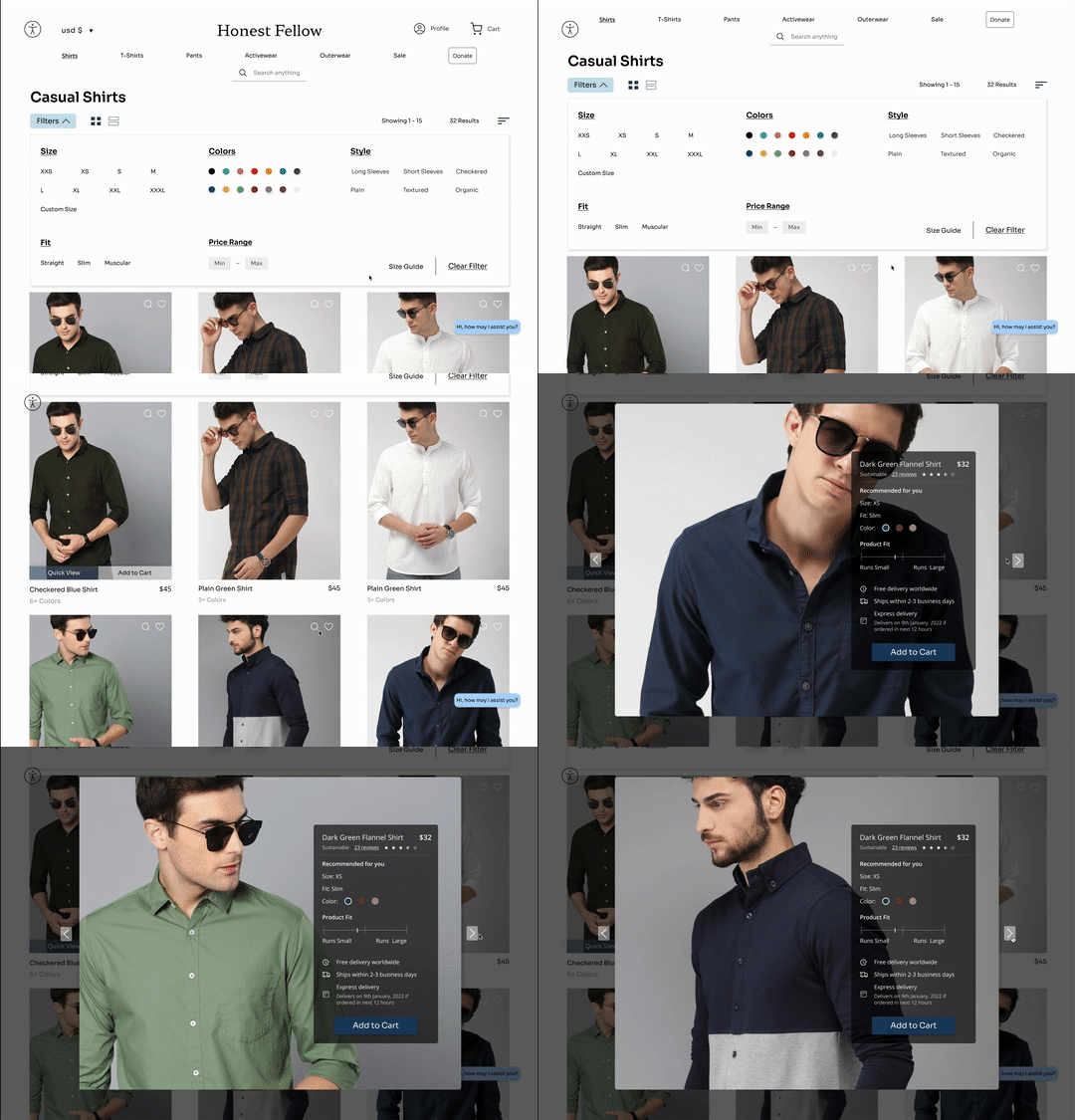
Quick Preview - Lightbox
According to The Journal of Retailing, there are two types of shopping motives and men tend to show more Utilitarian. This means men are more task-oriented. The same was observed during my primary research phase.
This feature enables users to quickly show an enlarged view of a product with all the necessary details a 'male' shopper would prefer to know before making a purchase.
Instagram InfluenceStudies also revealed that 42% of the users I interviewed were directed to a product through Instagram.
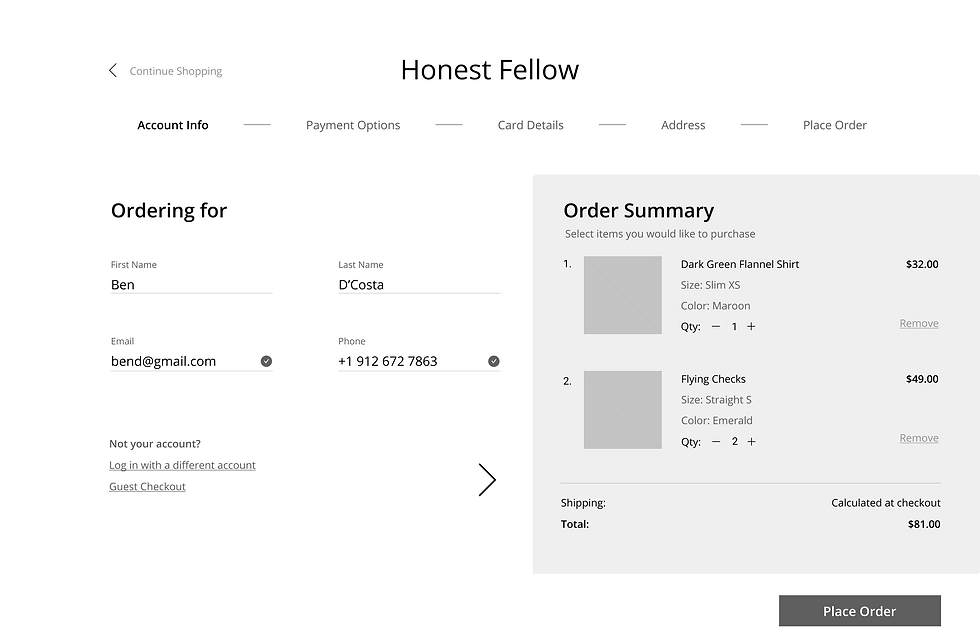
Checkout Process
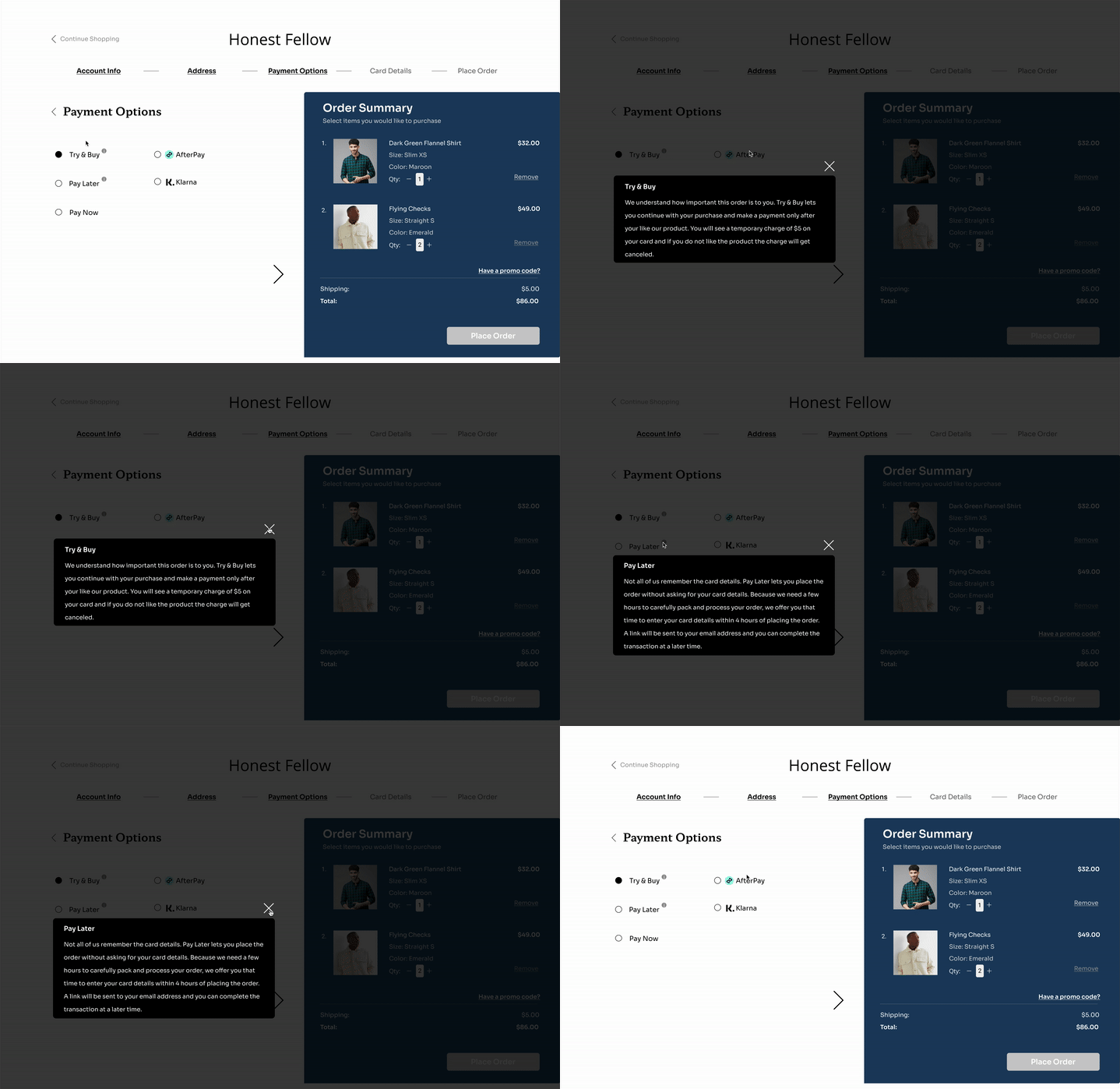
The checkout process is a 4 step process. For a registered user, all the fields are auto-populated based on the user account details and the process remains similar for any payment option.


Checkout Process
All the participants I interviewed and a few other people from my social network expressed that when they add a product to the cart, the checkout process is the phase where they abandon the cart.
This frustration usually occurs when users have to enter a lot of information to buy '1-2 products'.
The feature of 'Try & Buy' and 'Pay Later' gives more confidence to the buyers to hit the 'Confirm' button. It encourages them to think that 'Ok, I don't have to pay right away but my order is still being processed'
Final Thoughts
Donation
Today's generation shows empathy towards various causes. The awareness of sustainability, wellness of planet Earth, sensitivity towards workers is increasing. Hence, it is important to let the users know that buying from 'Honest Fellow' is in fact a step towards a good cause.
Information like how textile waste is harming the environment, how the brand supports workers through ethical manufacturing and how their donated clothes are doing good to millions in the world increases empathy towards the brand.


Conlusion
Impact
I conducted a usability testing with 3 users (people were kind of annoyed of me asking for help regarding the same topic, so I offered them coffee and a muffin!) after I finished the final prototype and these were the result.
-
The 'Quick View' feature increased the level of 'Happiness' in the overall shopping experience.
-
1 user expressed that the 'Pay Later' option is one of the best things since he likes to place an order quickly if he likes something and can enter card details later while the order is in process.
-
All users expressed that they would absolutely shop from a brand that provides free shipping for buying as well as donating old clothes.
Learnings
My initial phase of user interviews brought my research to a hard stop because of the responses that I received. I overcame this hurdle by asking my husband to take opinions from some of his friends to buy clothes and I took that as an opportunity to understand 'What' they look for and 'How' they feel about online shopping.
During the ideation phase, I jumped to making mock-ups without focusing on Information Architecture which made my process slower and unpolished. Later, I finished my 'Information Architecture' certificate and got a better understanding of its importance and how it's done.
My next step would be to have a better understanding of UI terminology and gain more knowledge by learning the basics of HTML and CSS to communicate my designs with the engineers.